Why AI Gets Business Questions Wrong More Often Than You Think

Imagine you're sitting in a quarterly business review. The discussion is moving quickly. Sales performance has been reviewed. Inventory levels have been discussed. Attention now shifts to profitability. Someone asks a simple question:
"Which product category generated the highest profit last quarter?"
Instead of turning to an analyst or waiting for a report, the team asks the company's AI assistant. Within seconds, an answer appears. The numbers look credible. The explanation is well structured. The response even highlights the factors that contributed to the result. The meeting moves on.
A few weeks later, someone discovers that the answer was based on gross margin rather than net profitability. The AI had access to the correct data. It performed the calculations accurately. What it lacked was an understanding of what the business meant by "profit."
This may sound like a minor issue, but it highlights one of the biggest challenges facing enterprise AI today. The greatest risk is not that AI produces answers that are obviously wrong. It's that AI can produce answers that appear completely reasonable while missing the business context that gives those answers meaning.
As organizations race to embed AI into analytics and decision-making processes, this distinction is becoming increasingly important.
We May Be Asking the Wrong Question About AI
Much of the conversation around enterprise AI focuses on intelligence, raising questions like these:
How powerful is the model? How quickly can it generate answers? How many tasks can it automate? Does the AI understand how your business works?
These are valid questions, but they often distract from a more fundamental one, because enterprise data is very different from the information AI encounters on the public internet. Every organization develops its own definitions, business rules, metrics, and operating assumptions over time, and these become deeply embedded in processes and systems, often without being formally documented. While humans learn these nuances through experience, AI does not, and that creates a gap between what the data says and what the business actually means.
The urgency around this issue is growing rapidly as AI adoption becomes mainstream across the enterprise.
When Simple Questions Become Surprisingly Complex
Consider a question that many executives ask regularly: "Who are our most valuable customers?" At first glance, it seems straightforward. However, ask the same question to five different leaders within an organization and you may receive five different answers.
None of these perspectives are wrong; the challenge is that each represents a different interpretation of the same question. Humans naturally understand that context matters, instinctively adjusting their interpretation based on who is asking and why, but AI does not have that advantage.
Without additional context, it must choose an interpretation on its own. Sometimes it chooses correctly. Sometimes it doesn't. The problem is that both answers may look equally convincing.
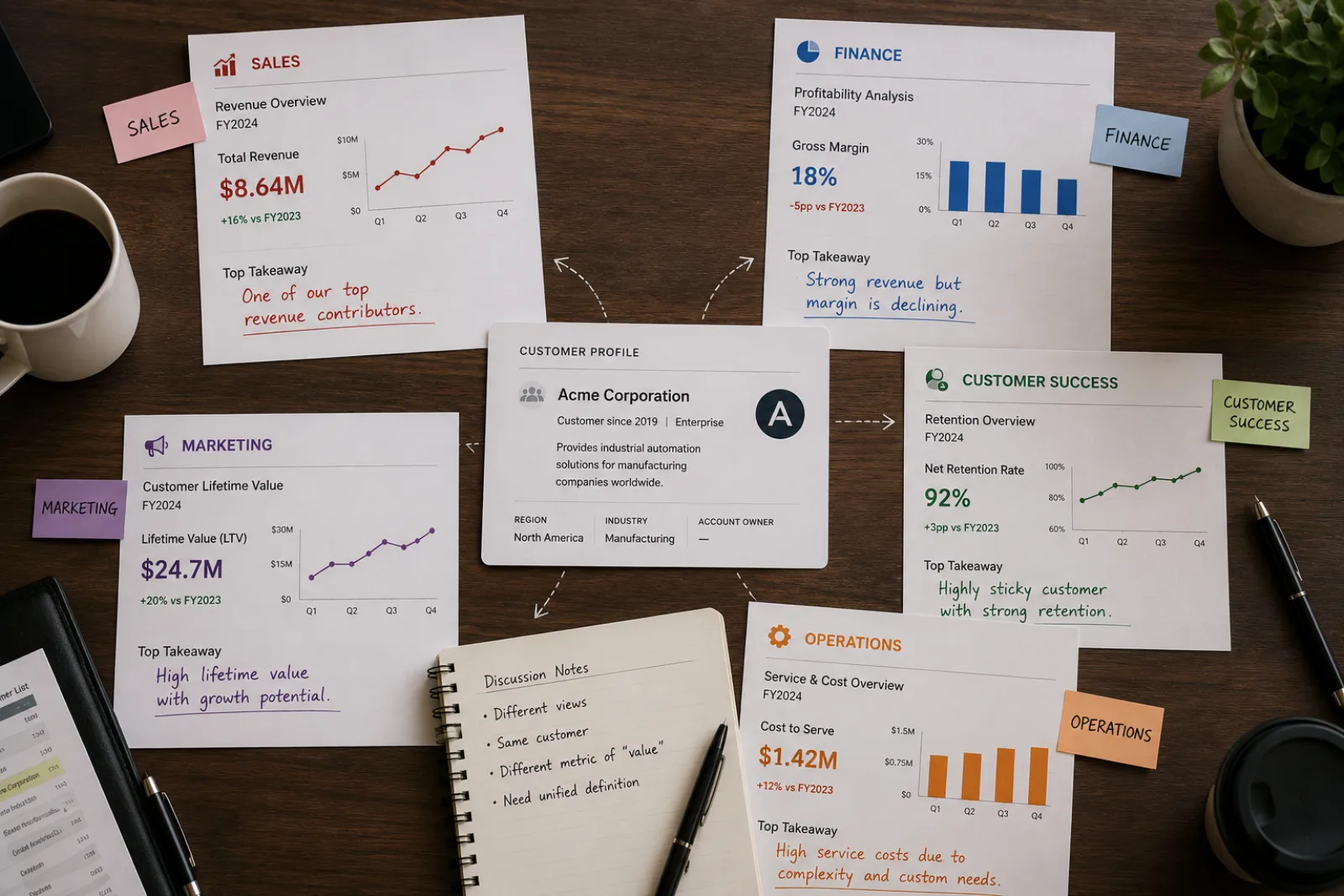
How the same business question yields different answers across departments.
Why More Data Doesn't Automatically Create Better Answers
When organizations encounter challenges with AI accuracy, the first instinct is often to focus on data quality: more data, more integrations, more systems, more history. While clean and complete data remains essential, it does not solve every problem. In many cases, enterprises already possess enormous amounts of information. The issue isn't a lack of data. It's a lack of shared understanding around that data.
Take inventory availability as an example. It sounds like a simple metric, yet different teams may calculate it differently:
- Some include safety stock. Others exclude it.
- Some account for inventory in transit. Others don't.
- Certain business units may use real-time availability, while others rely on daily snapshots.
The data itself may be perfectly accurate; the challenge lies in how that data is interpreted. This is why organizations sometimes discover that AI-generated answers can be technically correct while still being operationally misleading.
The calculations are accurate and the data is clean, yet the answer reflects a definition the business never intended.
The answer aligns with how the organization actually defines its metrics, so decision-makers can act on it with confidence.
The Enterprise Translation Problem
One way to think about this challenge is as a translation problem. Business leaders ask questions using business language, while systems store information using technical language, and AI sits in the middle attempting to translate one into the other.
For years, analysts played this role. When an executive asked a question, analysts understood the intent behind it. They knew which metrics mattered, which business rules applied, and which calculations were appropriate. They acted as translators between the business and the data.
AI is increasingly being asked to perform the same function. The difference is that experienced analysts understand organizational context, whereas AI only understands the context it has been given, and without that context it fills in the gaps itself. That is where many enterprise AI initiatives begin to encounter problems.
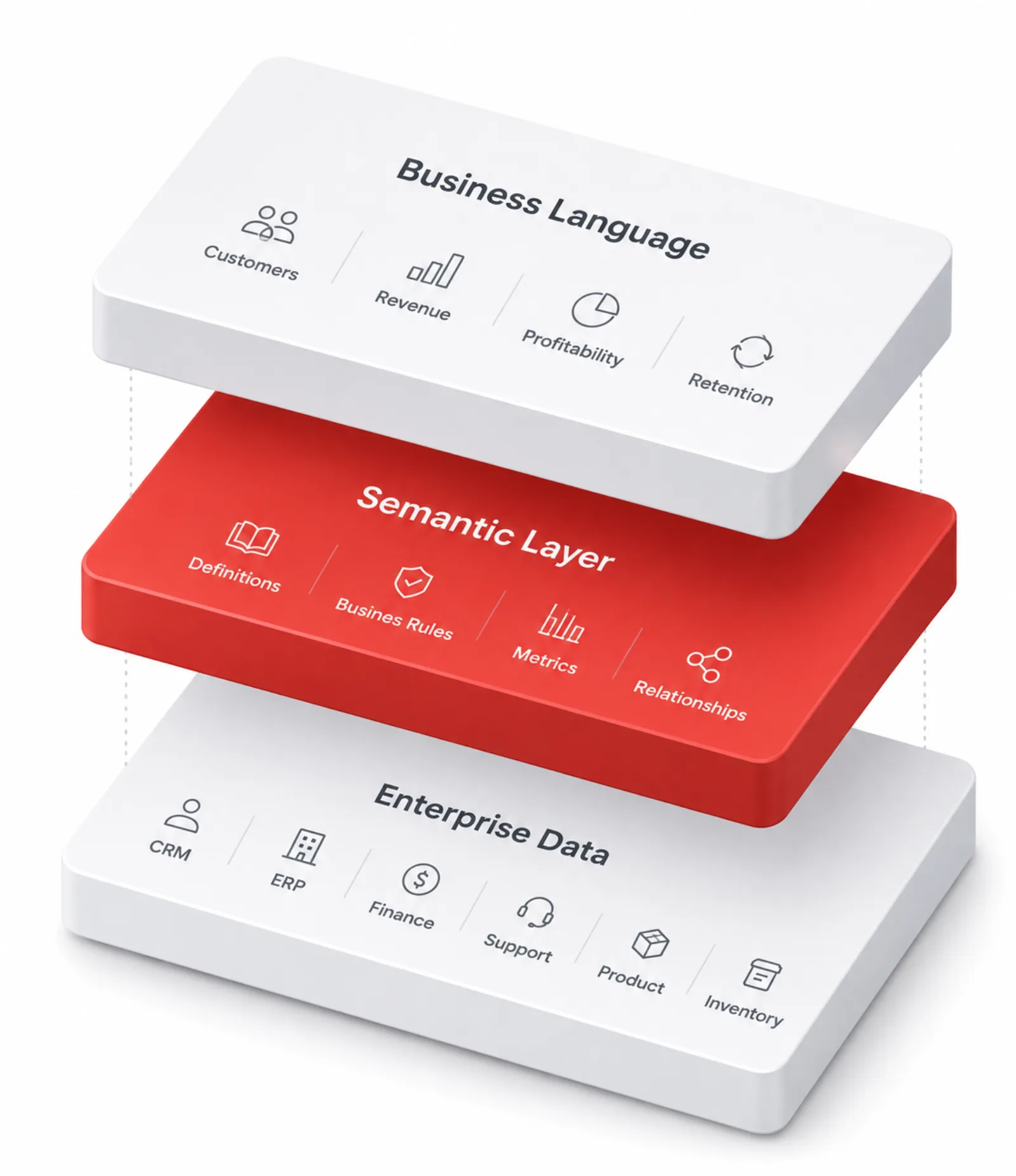
The semantic layer bridges business meaning and enterprise data systems.
AI systems can only be as reliable as the business context provided to them. Without that context, even sophisticated models can produce answers that are technically correct but operationally misleading.
This challenge becomes even more significant as AI scales across the enterprise. McKinsey's research highlights that while AI adoption continues to accelerate, organizations are increasingly focused on managing risks related to accuracy, governance, and decision quality.
Why Trust Is Becoming the Most Important KPI in AI
Most organizations evaluate AI based on productivity gains: how much time was saved, how many manual tasks were eliminated, how quickly answers can be generated. These metrics matter. However, there is another metric that may prove even more important over the long term: trust.
Imagine receiving an answer in three seconds but spending twenty minutes verifying whether it is correct: the productivity benefit disappears almost immediately. This is why trust sits at the center of every successful AI initiative. When users trust the answers, adoption accelerates, but when they do not, even the most advanced technology struggles to gain traction.
The future of enterprise AI will not be determined solely by how intelligent systems become. It will be determined by how trustworthy they become.
The Missing Ingredient: Business Context
The organizations achieving the strongest outcomes with AI tend to share a common characteristic. They spend less time focusing on the technology itself and more time focusing on the business context surrounding that technology.
- They invest in defining metrics consistently
- They align terminology across departments
- They establish governance around KPIs and calculations
- They create a shared understanding of what key business concepts actually mean
This is where semantic layers play a critical role. While often viewed as a technical data architecture component, semantic layers are increasingly becoming a foundational requirement for enterprise AI.
Gartner recently warned that neglecting semantics can lead to inaccurate and inefficient AI agents, exposing organizations to governance risks, poor business outcomes, and wasted AI investments. By creating a consistent business interpretation of data, semantic layers help ensure that AI understands concepts such as profitability, customer value, inventory availability, and fulfillment performance the same way the business does.
Despite the technical name, the concept is relatively simple. A semantic layer acts as a bridge between business meaning and enterprise data. It helps ensure that when someone asks a question about customers, profitability, inventory, or revenue, the system understands those concepts in the same way the organization does.
A bridge between business meaning and enterprise data, ensuring AI understands concepts like profitability, customer value, and inventory availability the same way the business does.
A Lesson From a Multi-Brand Retail Enterprise
A multi-brand retail organization faced a challenge that many enterprises are beginning to experience. The company wanted to make enterprise data more accessible through AI-powered interactions. Business users needed faster access to insights, but speed alone was not enough. The answers also needed to align with how the organization defined its key metrics and operational measures.
The solution was not simply about connecting AI to a data platform; it required creating a stronger relationship between business meaning and enterprise data, where context had to be preserved, definitions had to remain consistent, and governance had to be maintained.
Once that foundation was established, users were able to interact with data more naturally while maintaining confidence in the responses they received.
The outcome wasn't just faster access to information. It was more reliable access to information. And in enterprise environments, reliability is often what determines whether technology gets adopted at scale.
The Next Competitive Advantage May Not Be Better AI
Over the next few years, access to AI will become increasingly common, as most organizations will have powerful models, AI assistants, and advanced analytics capabilities. The differentiator will not be access to technology; it will be context.
The organizations that achieve the greatest value from AI will be the ones that invest in helping AI understand their business. They will define metrics consistently, establish governance around business terminology, and create clear connections between business concepts and enterprise data.
Because while AI models can understand language, they don't automatically understand what terms like profitability, customer value, inventory availability, or fulfillment performance mean inside your organization. That understanding must be built. And the organizations that build it well will be the ones that generate insights they can trust.
One Final Thought
As enterprises continue their AI journey, it's easy to focus on model performance, automation capabilities, and new features. Those things matter. But they are only part of the equation. The bigger question is whether AI understands the context behind the data it is analyzing.
- Can it interpret your business metrics the way your teams do?
- Can it distinguish between similar terms that have very different meanings across departments?
- Can it provide answers that are not only accurate, but aligned with how your organization actually operates?
Because in enterprise environments, the value of AI is not determined by how quickly it produces an answer, but by whether decision-makers trust that answer enough to act on it. And trust is rarely built through intelligence alone; it is built through context.
In the race to adopt AI, many organizations are investing heavily in models. The leaders will be the ones that invest equally in helping those models understand their business.
The future of enterprise AI isn't just about smarter models, it's about giving those models the right business context.
Exploring AI-powered analytics or conversational access to enterprise data?
We'd be happy to share our experience and lessons learned.
Get in touch